
Wine Stories Lab · results of the From Grapes to Stories project
A story worth believing.
We studied how wineries in Czechia, Hungary and Slovakia tell the story of sustainable wine – and what actually convinces customers. Here are all the results, and the tools to put them to work.
01 · Best Practice Guide
15 wineries, 15 ways to tell the wine story.
Between January and March 2026 we interviewed winemakers in three countries and audited their websites, labels and social media. Each profile shows what works in their storytelling, what they leave untapped and what other wineries can take from it.
 Full Best Practice GuidePDF · 65 pages · 3.88 MB ·Download
 SK-01
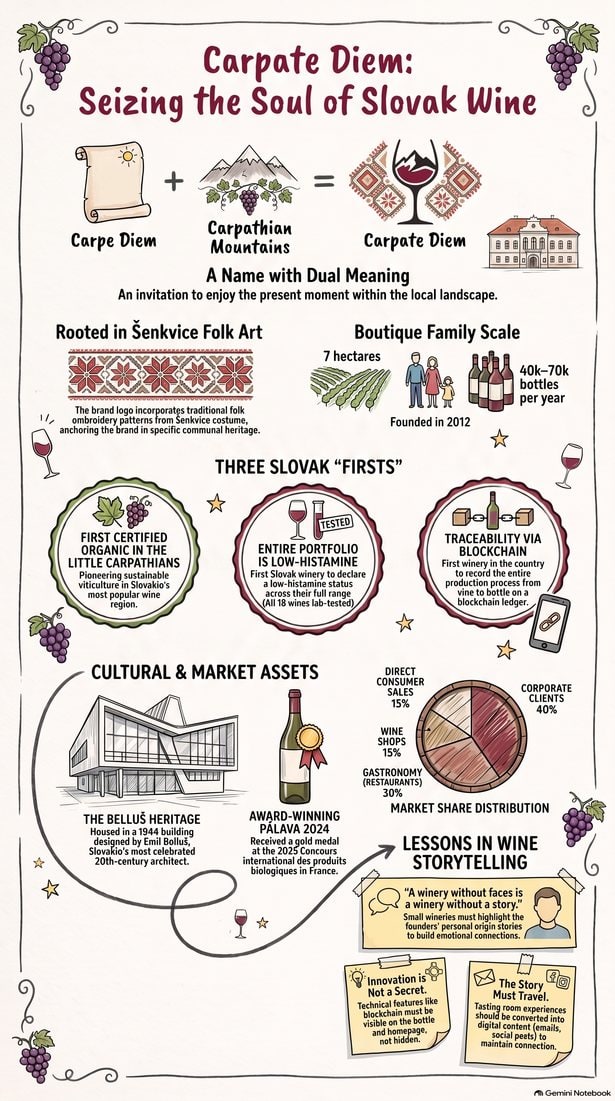
Carpate Diem
Pioneering
A family winery from the heart of the Little Carpathians making Slovakia's first certified organic, low-histamine wines in a building by national architect Emil Belluš, traceable from vine to bottle via blockchain.
What works for them
- A name that encodes philosophy and place
- Terroir ownership through the Little Carpathians
- In-person experience as the primary channel
“We use storytelling, although perhaps not as systematically as we could. We receive many visitors and organise tastings, but we need to improve how we convert these experiences into customer loyalty and purchases.”
– Co-owner, February 2026
Four lessons for other wineries
- A winery without faces is a winery without a story
- Innovation that no one sees is not innovation, it is a secret
- A statistic is a fact. A human story is a brand
- The tasting-room story must travel beyond the tasting room
Most useful for: Small and medium wineries with strong technical practices and weak digital storytelling.
 SK-02
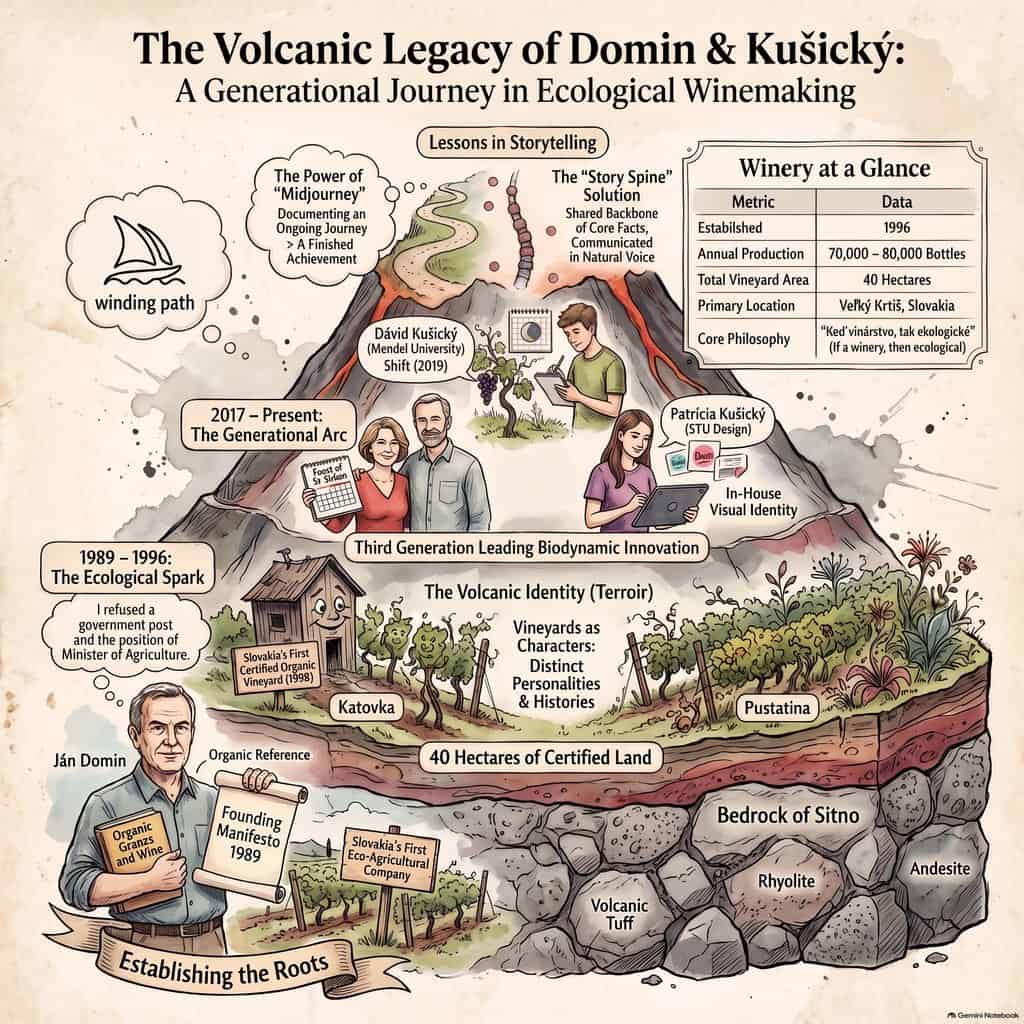
Domin & Kušický
Family & generations
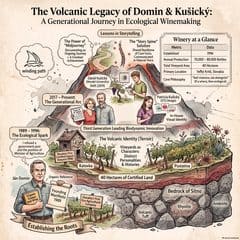
Slovakia's oldest ecological winery: three generations driven by one founding conviction, “If a winery, then ecological”, now pioneering biodynamics in the forgotten land of Veľký Krtíš.
What works for them
- Seven named family members with photos and e-mails
- The Katovka blog post: a world-class vineyard story
- Named vineyards as characters in the wine names
“I would not say that I use storytelling as a consciously learned marketing technique. Rather, it happens naturally and spontaneously when I talk to customers. The story emerges naturally from the product itself and our way of working.”
– Dávid Kušický, February 2026
Four lessons for other wineries
- A great story told differently every time is a fragmented brand
- Your founding manifesto belongs on every touchpoint
- A proven content format is wasted if it appears once
- An ongoing transition is more powerful than a completed achievement
Most useful for: Multi-generational family wineries with strong heritage and inconsistent digital communication.
 SK-03
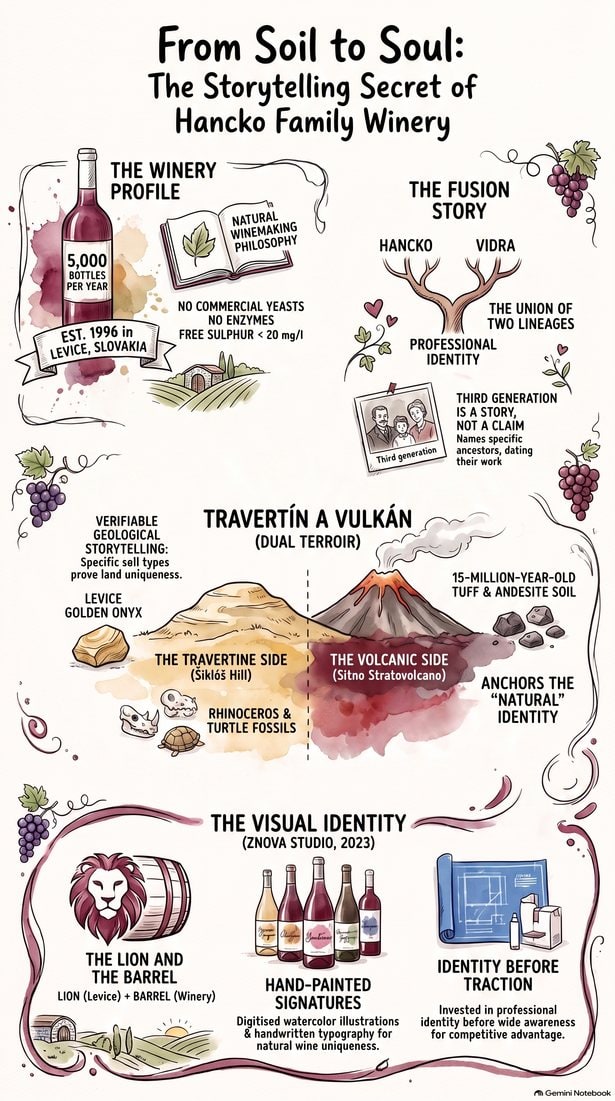
Hancko Family Winery
Design & label
A young family winery in the heart of Levice, born from the fusion of two family lineages (Hancko and Vidra) reaching back three generations, making natural wines on the dual terroir of the travertine hill Šiklóš and the volcanic foothills of the Štiavnica Mountains.
What works for them
- Professional brand identity from a named designer
- An articulated “Travertín a Vulkán” terroir story
- Watercolour illustrations as a visual signature
“Through a distinctive identity, we emphasise the winery's origin. The striking symbol combines a lion representing Levice and a barrel, symbolising the winery. The handwritten brand name communicates the uniqueness of the product.”
– Martin Machala, ZNOVA studio, 2023
Four lessons for other wineries
- Investing in identity before traction is a competitive advantage
- Geological storytelling makes terroir verifiable
- “Third generation” is a claim – names are a story
- A story of two families joining forces is rare
Most useful for: Young, design-led wineries with a strong visual identity but under-developed human and community storytelling.
 SK-04
Víno Magula
Place & landscape
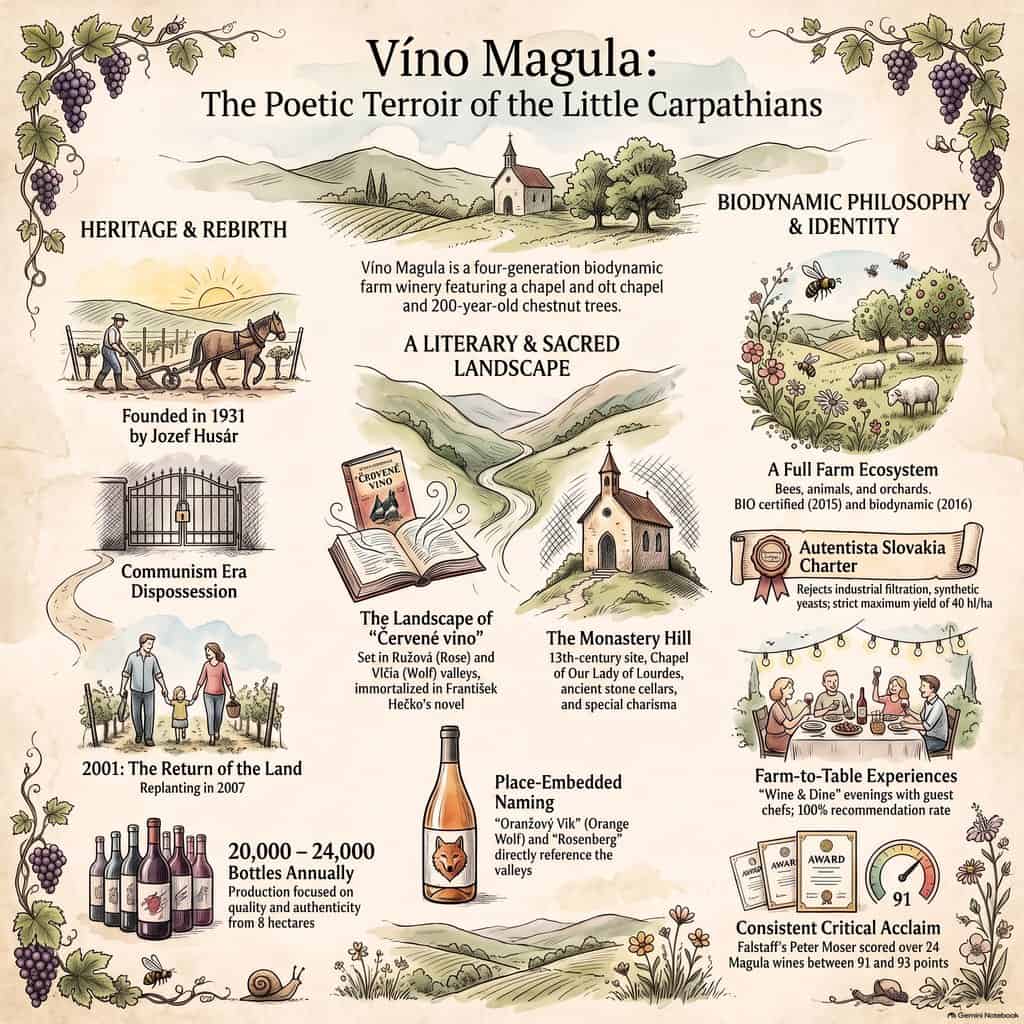
A four-generation biodynamic farm winery on a former monastery hill in the Little Carpathians, continuing a great-grandfather's 1931 vineyard in the very valleys immortalised by Slovakia's most beloved wine novel, and a member of the Autentista Slovakia charter community.
What works for them
- Wine names that carry the place into the product
- Farm-to-table dinners as a recurring brand experience
- Archive photographs from 1931 published online
“Historically, our winery has had very limited systematic marketing communication, which I recognise as one of our main weaknesses. Our original strategy focused primarily on producing wine and selling it through professional partners rather than engaging directly with end consumers.”
– Magula, February 2026
Four lessons for other wineries
- Literary, cultural and historical context is rare
- Membership in a credible collective is a brand asset
- An ancestor's photograph is not a story – until you write the story
- An atmospheric place must be photographed atmospherically
Most useful for: Small wineries with extraordinary places, deep heritage and underdeveloped digital storytelling.
 SK-05
Strekov 1075
Founder's voice
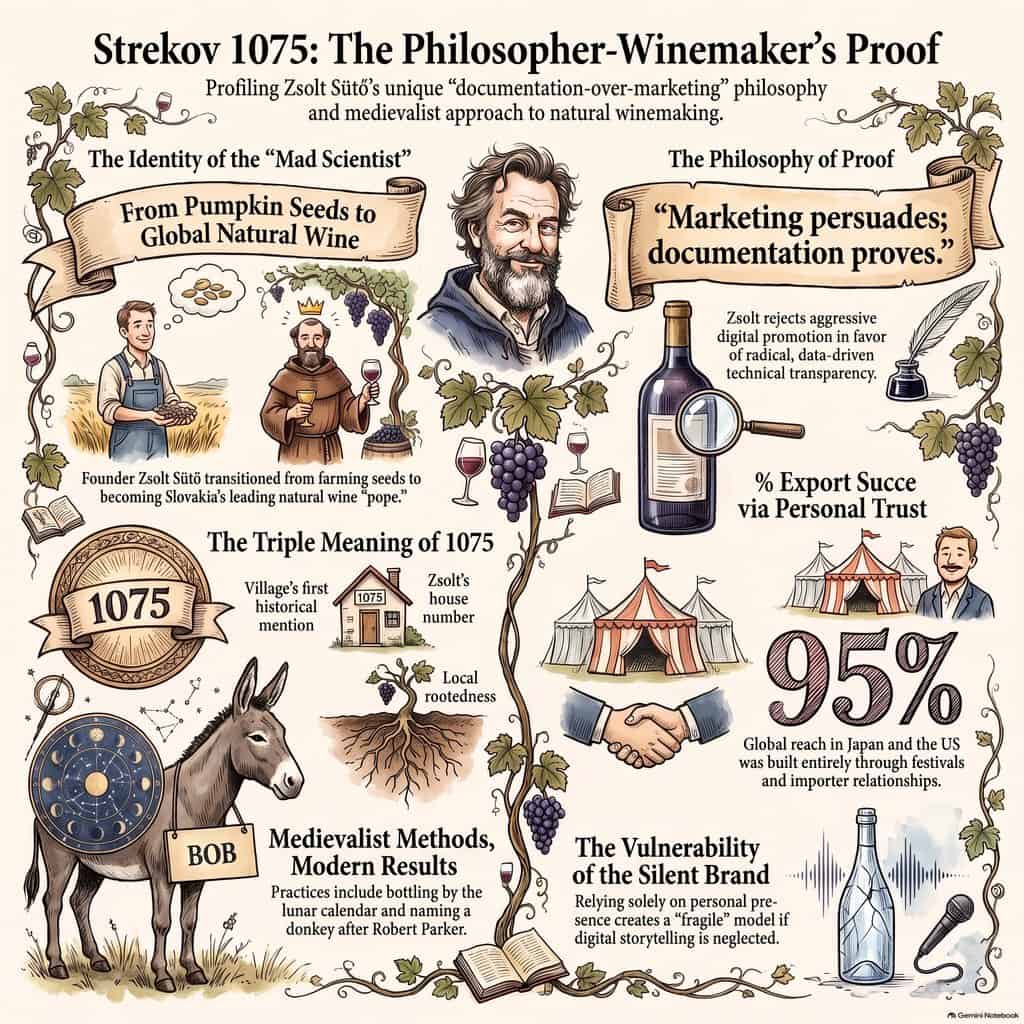
A former pumpkin-seed farmer turned philosopher-winemaker who became the first Slovak natural winemaker known worldwide – bottling by the lunar calendar, naming his donkey after Robert Parker, and serving as a founding voice of the Autentista Slovakia charter community.
What works for them
- The number 1075 – three meanings in one mark
- Radical technical transparency on every wine
- Direct relationships with international importers
“I understand storytelling as the communication of the deeper meaning and identity behind the wine… storytelling is not an artificial narrative but a truthful expression of origin, place, and continuity.”
– Zsolt Sütő, February 2026
Four lessons for other wineries
- Documentation is not marketing – it is transparency at scale
- Brand fragility is a real risk for relationship-only businesses
- The bigger the importer's story, the bigger the home-channel gap
- An unexplained detail is a wasted story
Most useful for: Export-focused, philosophy-driven small wineries built around a singular founder voice.
 HU-01
Dobosi Winery
Family & generations
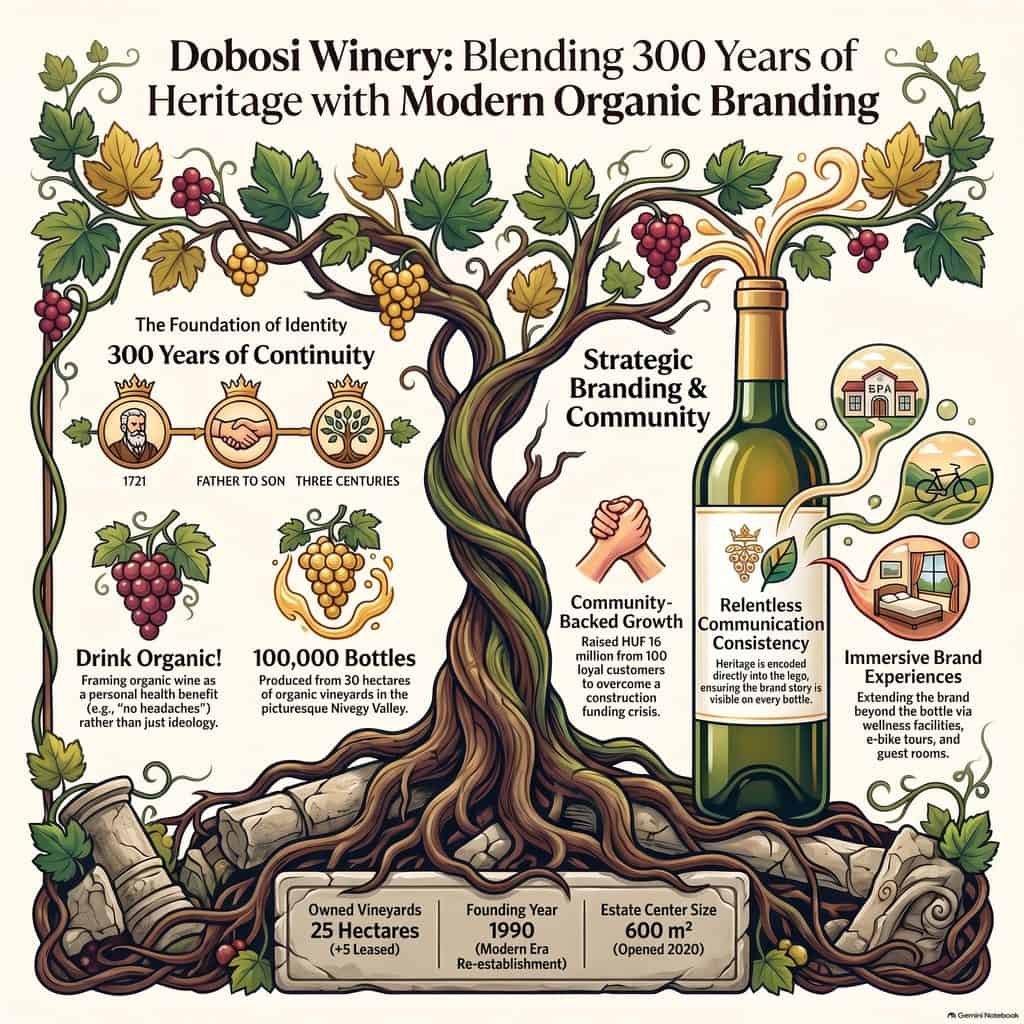
A 300-year-old family winery in the Nivegy Valley of the Balaton Highlands, where “Drink organic!” is both a motto and a business philosophy – combining three centuries of grape-growing tradition with full organic certification, a modern wine estate and year-round hospitality.
What works for them
- Heritage encoded directly into the logo
- “Drink organic!” – a single, repeatable motto
- Hospitality as an immersive brand experience
“Self-identity is important – it is original, it is built on trust, and it builds trust. Personal touch and the importance of sustainability matter even in the online store.”
– Győző Dobosi, February 2026
Four lessons for other wineries
- It is not enough to have a story – you must communicate it relentlessly
- Translate values into a benefit the customer can feel
- Tradition does not mean old-fashioned
- Owned-channel reach is the multiplier for every good story
Most useful for: Heritage-rich family wineries building agri-tourism and direct-to-consumer loyalty.
 HU-02
Váli Winery
Place & landscape
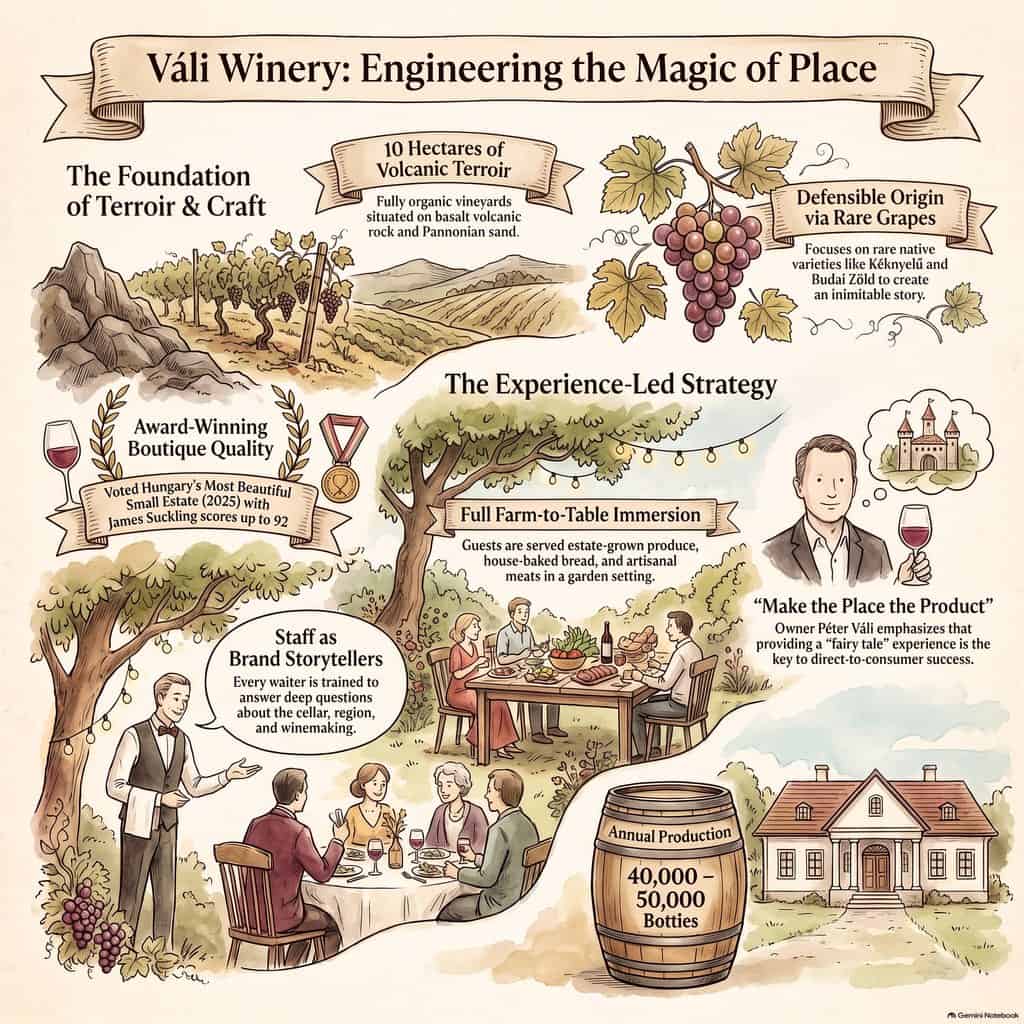
A small organic estate in Badacsonyörs where wine is still a passion rather than a job – voted Hungary's Most Beautiful Small Estate in 2025 and built around one promise: “Come and visit us and experience the magic of this place for yourselves.”
What works for them
- “The magic of the place” – a single clear message
- Full farm-to-table immersion as the product
- Staff trained as storytellers
“The hardest thing is to provide a good experience, because it is very labour-intensive and requires investment. It's like a good restaurant where you walk in and find yourself in a fairy tale. It is always the experience that makes you unique.”
– Péter Váli, February 2026
Four lessons for other wineries
- A winery's strongest story can be a feeling, not a fact
- If you must sell direct, make the place itself the product
- Rare native grapes are an unbeatable terroir story
- Train your staff to be storytellers, not servers
Most useful for: Small, hospitality-led, direct-to-consumer wineries in scenic, tourism-driven regions.
 HU-03
Tokaj Pendits
Pioneering
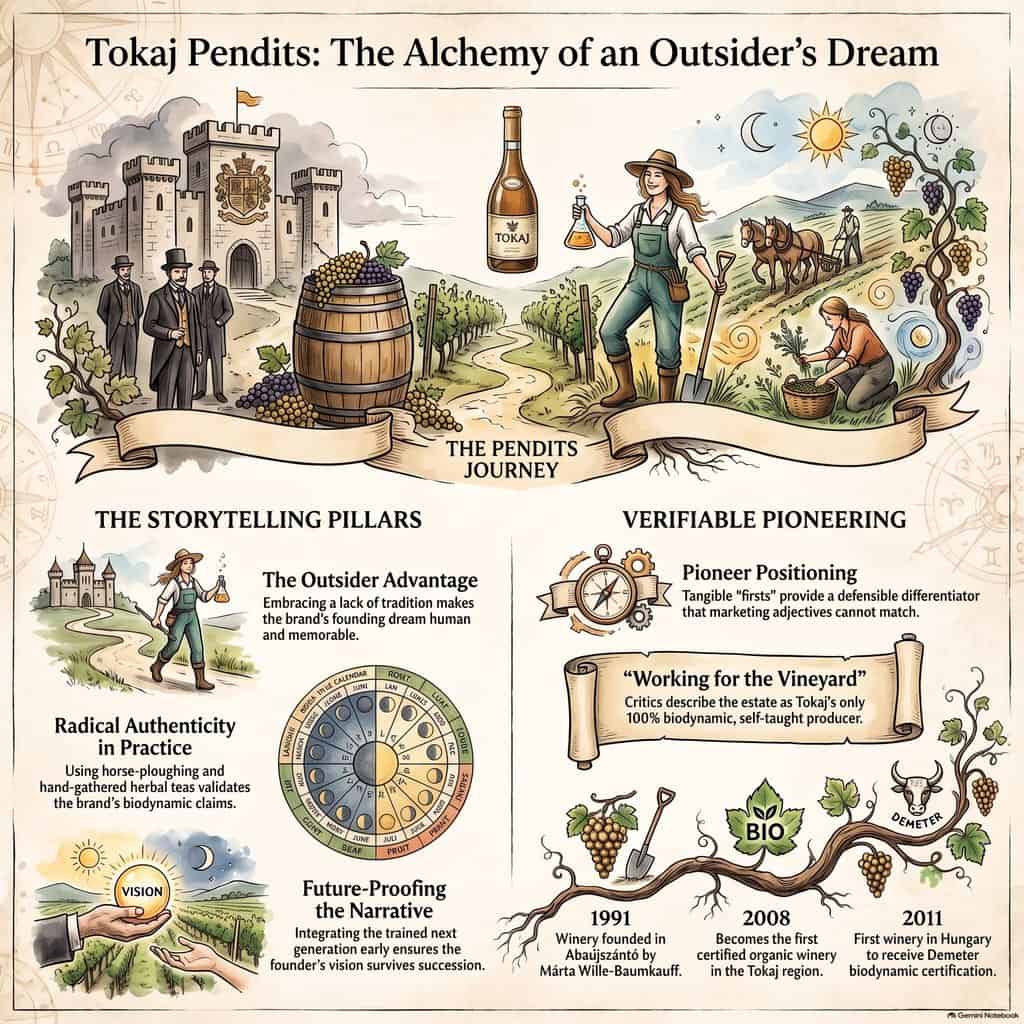
A family biodynamic estate at the northern edge of Tokaj, founded on a single audacious dream: a Hungarian woman with no winemaking background who became the pioneer of biodynamic viticulture in Hungary and created the country's first Demeter-certified winery.
What works for them
- “I had a dream…” – a founding story told in the first person
- Pioneer positioning backed by verifiable firsts
- Earned external storytelling and elite networks
“Márta is one of the most genuine and humble winemakers I have ever met. She has no interest in competitions or medals. She simply aspires to make quality wine, governed by the vineyard.”
– Visiting wine critic, The Grand Crew
Four lessons for other wineries
- The absence of tradition can be a stronger story than tradition itself
- A verifiable “first” is the most defensible differentiator
- When the practice is real, the practice is the story
- A brand built on one founder must tell its succession story early
Most useful for: Founder-led, sustainability-driven premium wineries built on a pioneer position and one strong personal story.
 HU-04
Korózs Winery
Founder's voice
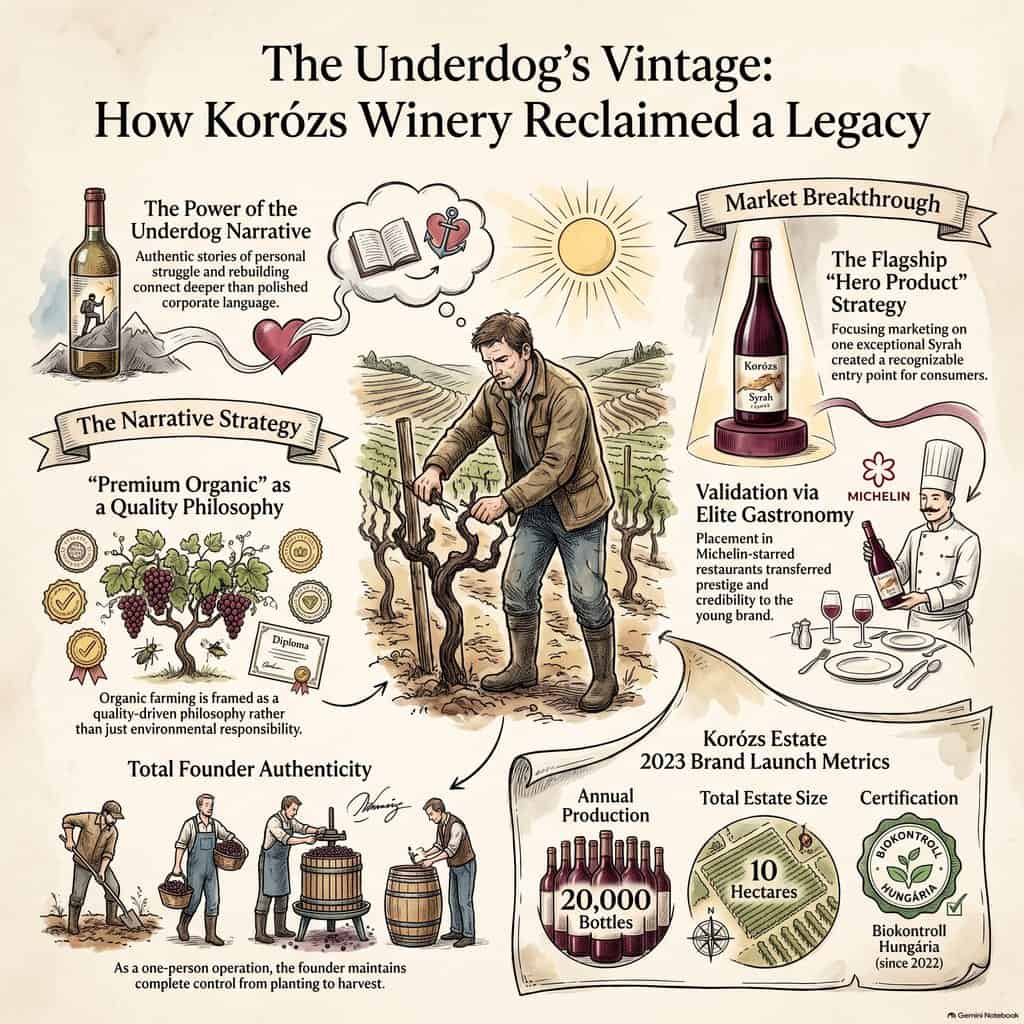
A one-person, fully family-owned organic estate on the volcanic and limestone slopes of Eger, where a viticulture graduate who grew up in his father's vineyard returned to relaunch the family name in 2023 – and built a benchmark Syrah that now pours in Michelin-starred restaurants.
What works for them
- The Syrah Superior as a signature flagship
- “Premium, organic wines from Eger” – a clear tagline
- The young-winemaker underdog narrative
“As I grow older, I feel more fulfilled by the closeness to nature and the vineyard. More and more, I see true value in balance, harmony, and preserving the values and traditions of this historic wine region.”
– Dániel Korózs
Four lessons for other wineries
- A single flagship wine can carry an entire young brand
- Let elite gastronomy validate you
- The underdog story is one of the most engaging narratives there is
- For solo operations, the struggle is the story
Most useful for: Young, founder-led, small-scale wineries in traditional regions seeking a modern, premium identity.
 HU-05
Karner Winery
Founder's voice
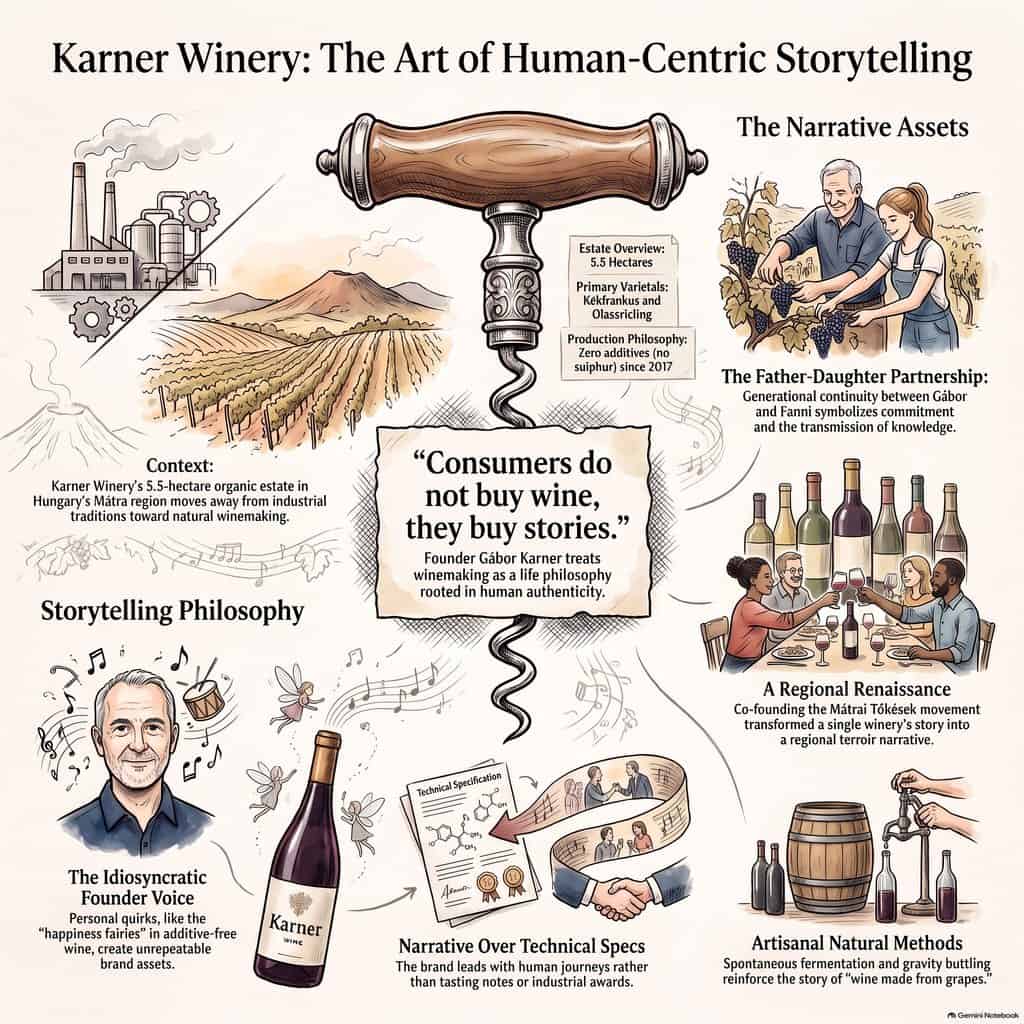
A former jazz-rock drummer who funded his winemaking with night shifts as a watchman and turned it into one of Hungary's most recognised natural-wine estates – now run with his daughter Fanni on the volcanic slopes of the Mátra, with no additives at all since the 2017 vintage.
What works for them
- “People buy stories, not wine” as an explicit philosophy
- The father–daughter partnership as a living narrative
- A memorable, idiosyncratic founder voice
“Despite the look of things, we aren't doing anything new. On the contrary, we make our wine as they did in the older times – with the help of copper and sulphur in the vineyard, and without using anything in the cellar.”
– Gábor Karner
Four lessons for other wineries
- The most powerful wine stories are about people, not products
- An idiosyncratic founder voice is an unrepeatable asset
- A genuine philosophy beats a sustainability slogan
- A founding movement turns one winery's story into a region's story
Most useful for: Small, founder-led natural wineries with a strong personal character and a tasting-led, direct-to-consumer model.
 CZ-01
Vinařství Čech
Family & generations
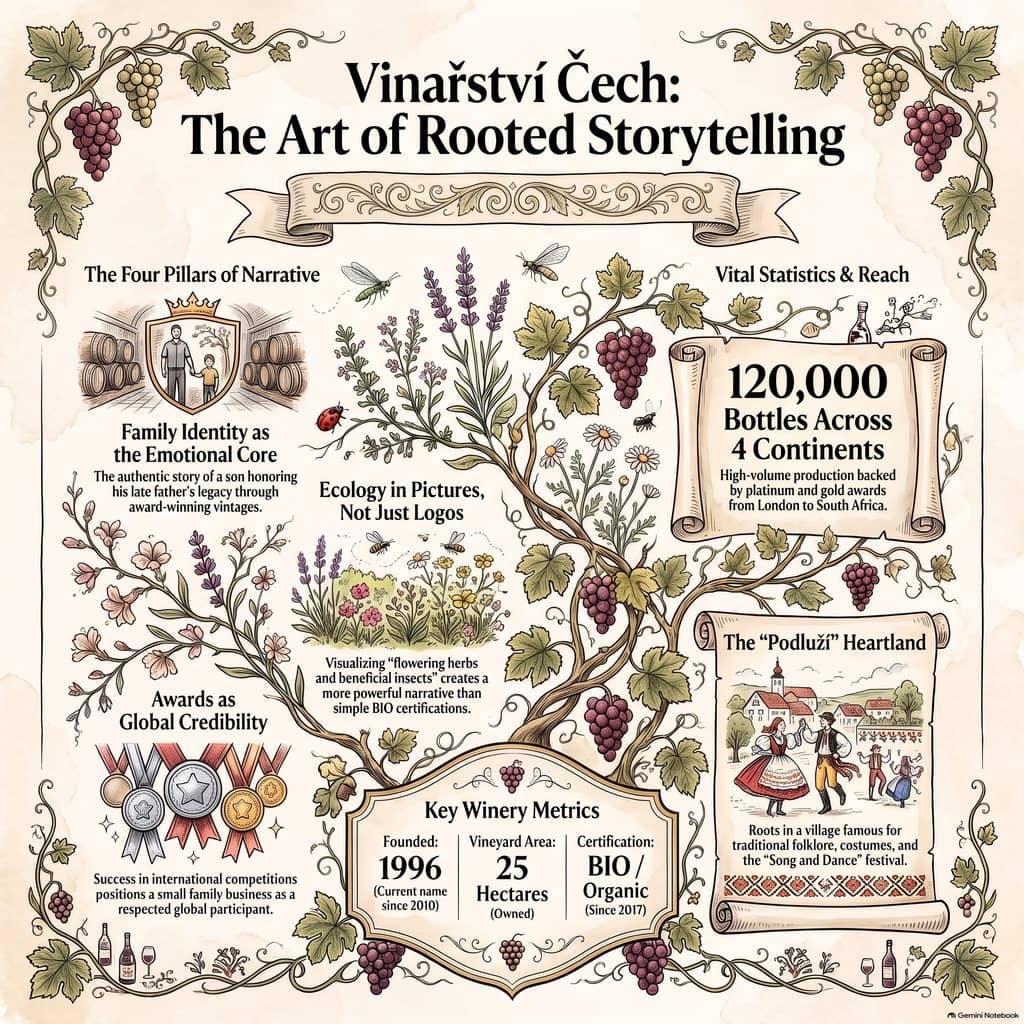
A family winery in the folklore heartland of Podluží, South Moravia, where a son took over his late father's cellar and, in his very first vintage, won more awards than the winery had ever seen – carrying “Moravian wines from Čech” onto podiums across four continents.
What works for them
- Family identity as the emotional core
- International awards as external validation
- Ecological values told through vivid imagery
“The winery was founded and made famous by Jan Čech – a winemaker in body and soul, who now unfortunately looks down on us only from wine heaven.”
– Vinařství Čech on its founder († 2011)
Four lessons for other wineries
- Consistency across themes builds a memorable identity
- Describe ecology in pictures, not certifications
- Awards let a small producer borrow global credibility
- A succession story is one of the most human narratives a winery has
Most useful for: Family-run, award-winning, tradition-rooted wineries that are strongest in person but under-developed online.
 CZ-02
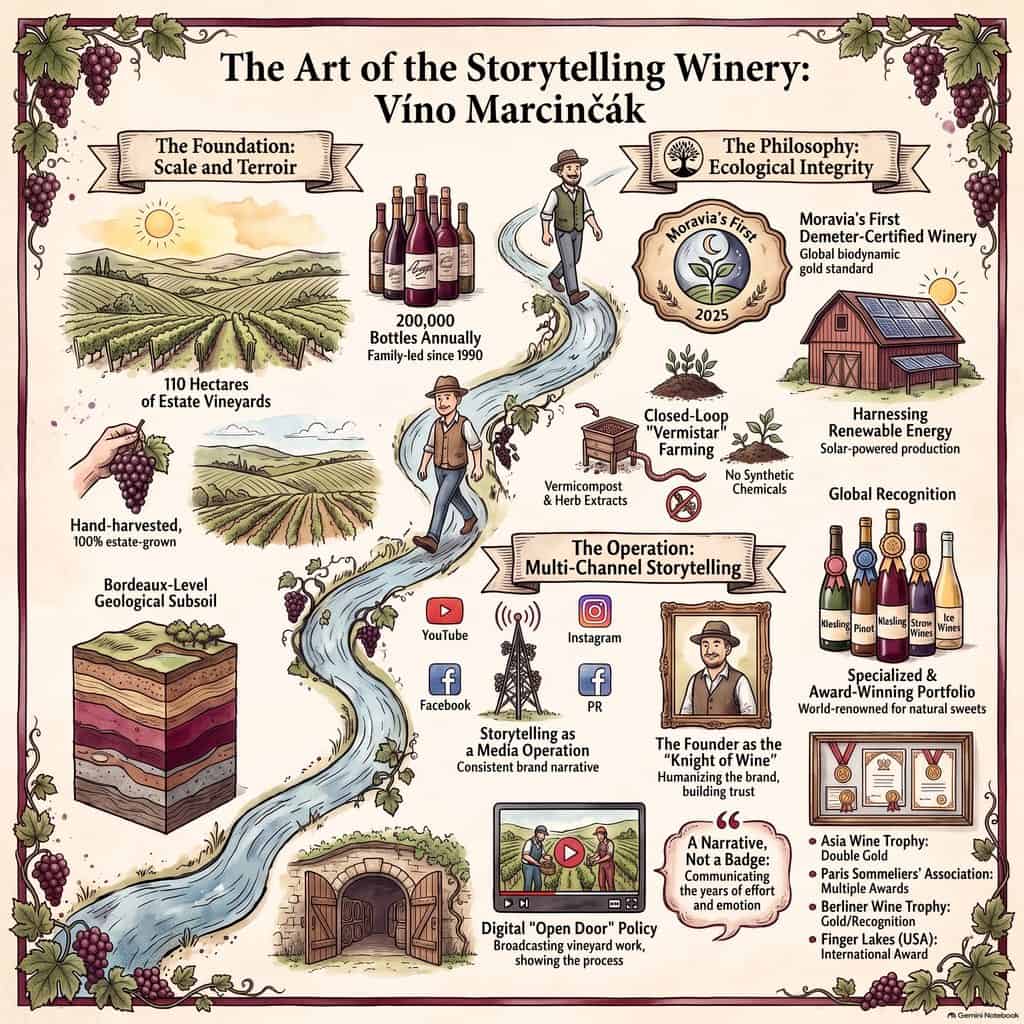
Víno Marcinčák
Content & channels
A family organic winery in Novosedly, in the prestigious Mikulov sub-region: the largest organic grape grower in the Czech Republic and, since 2025, the first Demeter-certified biodynamic winery in Moravia – turning three decades of ecological commitment into a living brand narrative.
What works for them
- A genuine multi-channel content operation
- The Demeter journey told as a story, not a badge
- The founder as the human face of the brand
Four lessons for other wineries
- Narrate the journey to a certification
- Behind-the-scenes transparency turns curiosity into trust
- Run storytelling as an operation, not an afterthought
- At scale, the personal narrative must work harder, not disappear
Most useful for: Organic and biodynamic wineries scaling production while keeping a values-driven, multi-channel brand.
 CZ-03
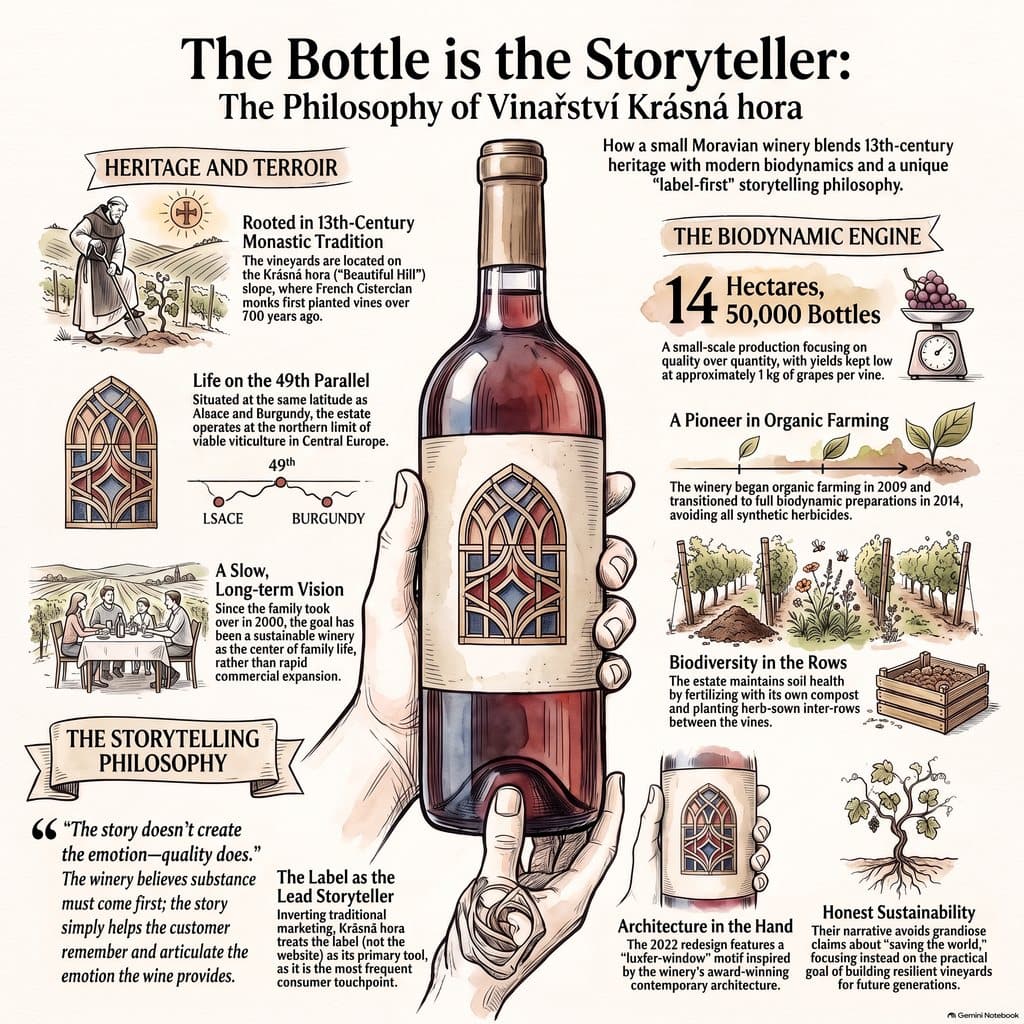
Vinařství Krásná hora
Design & label
A small family winery in Starý Poddvorov, South Moravia, farming French varieties on a slope first planted by Cistercian monks in the 13th century – an early biodynamic pioneer, named Czech Winery of the Year in New York, whose label is the single most important carrier of its story.
What works for them
- The label as the brand's primary “business card”
- Ecology as the main story, not a side note
- A relationship-first storytelling philosophy
Four lessons for other wineries
- The label is often the most-seen storyteller
- The story doesn't create the emotion – quality does
- An authentic “we did it first” is undeniable differentiation
- Frame sustainability honestly, not grandiosely
Most useful for: Design-conscious, sustainability-driven, export-oriented wineries that treat label and architecture as core storytelling assets.
 CZ-04
Vinařství Špalek
Place & landscape
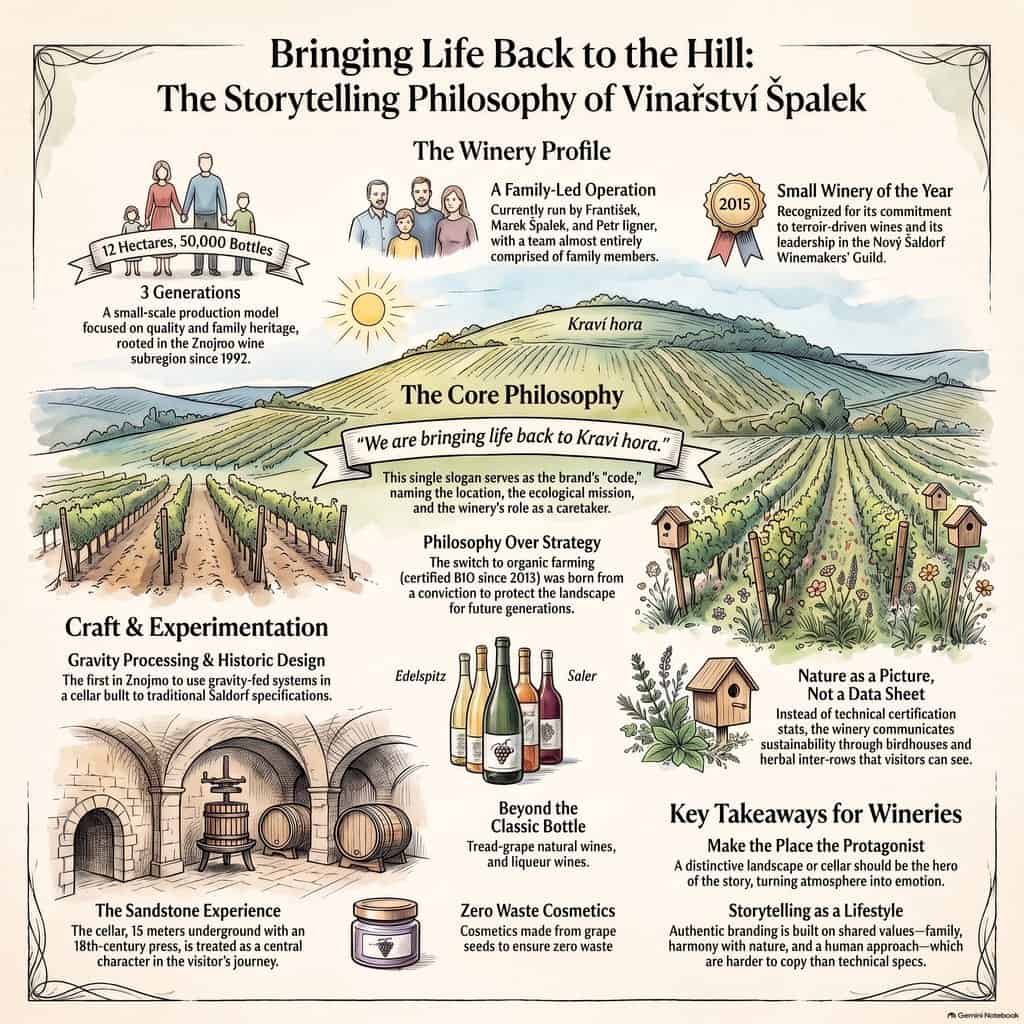
A three-generation family organic winery in Nový Šaldorf near Znojmo, farming a single famous hill, Kraví hora, with a story built on one clear promise: “We are bringing life back to Kraví hora.”
What works for them
- “We bring life back to Kraví hora” – one memorable slogan
- Organic farming framed as a philosophy of life, not a strategy
- Emotion through shared values and lifestyle
“Our wines are not about trends, but about honest work, trust in nature, and a long-term vision. Whether you visit us in Nový Šaldorf or open our bottle at home, I hope you find a piece of our story in the wine.”
– Marek Špalek
Four lessons for other wineries
- One perfect slogan can carry an entire philosophy
- Make sustainability a picture, not a data sheet
- A distinctive place can be the protagonist, not the backdrop
- Extend the story beyond the bottle
Most useful for: Family-run, experience-led, sustainability-driven wineries with a remarkable cellar or landscape and a clear guiding philosophy.
 CZ-05
Dobrá Vinice
Pioneering
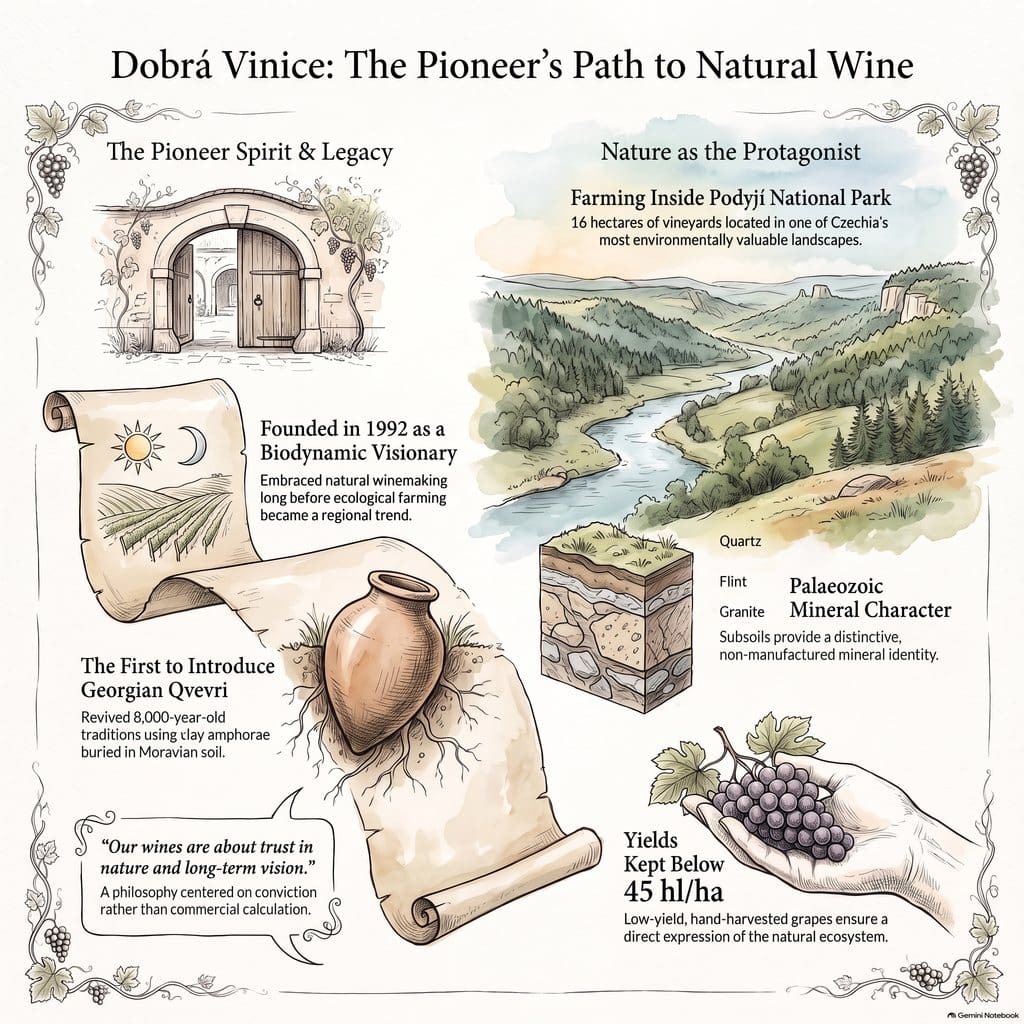
A family winery in Nový Šaldorf near Znojmo, widely regarded as one of the pioneers of biodynamic and natural winemaking in the Czech Republic – farming inside a national park, and the first Czech producer to make wine in Georgian qvevri amphorae, an 8,000-year-old tradition.
What works for them
- Pioneer of biodynamic and natural winemaking
- Nature as the central character – a national park
- Ancient craft – the Georgian qvevri story
Four lessons for other wineries
- Being a pioneer is the most durable brand story there is
- One ownable practice can carry the whole authenticity story
- Let the landscape be the protagonist
- A founder-led brand must plan the continuity story
Most useful for: Pioneering, founder-led natural and biodynamic wineries with a distinctive practice and a strong sense of place.
02 · Consumer Insights Report
Consumers believe the story. Paying more for it is the next step.
We asked 698 consumers in Slovakia, Hungary and Czechia how they perceive stories about ecological wine. The result has a clear order: people readily find the story credible, but are much slower to pay more for it or to feel emotionally attached.
Where the story lands – and where it doesn’t
Share of respondents with high and low agreement on a 1–7 scale
Show the data as a table
| Outcome | High agreement | Low agreement |
|---|---|---|
| Perceived authenticity | 57% | 7% |
| Loyalty | 37% | 16% |
| Willingness to pay | 26% | 21% |
| Emotional engagement | 28% | 32% |
Four steps from trust to value
The sequence the report recommends for ecological wine communication
- Make it believableGround the ecological claim in place and production practice.
- Make it meaningfulConnect the practice to care, stewardship and people.
- Make it valuableExplain what the practice changes for quality, land or scarcity.
- Make it continuousKeep the story visible after purchase through updates and proof.
The highest willingness to pay (4.28) and loyalty (4.63).
The highest authenticity (5.14) but the lowest emotional engagement (3.46).
The strongest emotional engagement (4.07) and balanced other outcomes.
Country differences are statistically significant, but they do not explain why. Messages are best tested in each market separately.
The full report
28 pages with all charts, the method and recommendations for wineries.
Cite as: STORY4WINE consortium (2026). Consumer Insights Report. From Grapes to Stories project, IVF 22510339. Licence CC BY 4.0.
03 · Producer database
102 eco and organic producers from Czechia, Hungary and Slovakia
An overview of wineries making ecological, biodynamic or natural wine. For each one we show how firmly we verified its status – because “eco” on a website is not yet a certificate.
Certificate verified in an official source or with the control body.
Biodynamic certification (e.g. Demeter) verified with the certifier.
The winery presents an ecological or natural approach; no certificate verified.
| Producer | Country | Region | Town | Verification | Link |
|---|---|---|---|---|---|
| Bakonyi Pince | Hungary | Villány | Villány | Certified organic | Website ↗ (opens in a new window) |
| BOHEMIA SEKT, s.r.o. | Czechia | — | Starý Plzenec | Certified organic | Website ↗ (opens in a new window) |
| Bussay Pince | Hungary | Zala | Csörnyeföld | Certified organic | Website ↗ (opens in a new window) |
| Demeter Zoltán / Demetervin | Hungary | Tokaj | Mád | Certified organic | Website ↗ (opens in a new window) |
| Gróf Degenfeld Szőlőbirtok / Degenfeld Borászat | Hungary | Tokaj | Tarcal | Certified organic | Website ↗ (opens in a new window) |
| KARPATSKÁ PERLA, s.r.o. | Slovakia | Malokarpatská | Šenkvice | Certified organic | Website ↗ (opens in a new window) |
| Koch Borászat | Hungary | Hajós-Baja | Borota | Certified organic | Website ↗ (opens in a new window) |
| MAGULA Family Winery | Slovakia | Malokarpatská | Suchá nad Parnou | Certified organic | Source ↗ (opens in a new window) |
| Quiar Birtok | Hungary | Balaton | Balatonfőkajár | Certified organic | Website ↗ (opens in a new window) |
| Rodinné vinařství Jedlička, Bořetice a.s. | Czechia | Morava | Bořetice | Certified organic | Website ↗ (opens in a new window) |
| Rodinné vinařství Pavel Binder | Czechia | Morava | Rakvice | Certified organic | Source ↗ (opens in a new window) |
| Rubin Borászat | Hungary | Balaton | Balatonkeresztúr | Certified organic | Website ↗ (opens in a new window) |
| Steigler Pincészet | Hungary | Sopron | Sopron | Certified organic | Website ↗ (opens in a new window) |
| Szóló | Hungary | Tokaj | Tállya | Certified organic | Source ↗ (opens in a new window) |
| TOKAJ MACIK WINERY s.r.o. | Slovakia | Tokajská | Malá Tŕňa / Tokaj area | Certified organic | Website ↗ (opens in a new window) |
| Tokaj-Hétszőlő Organic Vineyards | Hungary | Tokaj | Tokaj | Certified organic | Website ↗ (opens in a new window) |
| Vinařství Ing. Josef Abrle | Czechia | Mikulovská | Pavlov | Certified organic | Source ↗ (opens in a new window) |
| Vinařství Čech s.r.o. | Czechia | Slovácká | Tvrdonice | Certified organic | Source ↗ (opens in a new window) |
| VINKOVA | Slovakia | Malokarpatská | Pezinok | Certified organic | Website ↗ (opens in a new window) |
| VINSELEKT MICHLOVSKÝ a.s. | Czechia | Morava | Rakvice | Certified organic | Website ↗ (opens in a new window) |
| VÍNO NATURAL Domin & Kušický | Slovakia | Stredoslovenská | Veľký Krtíš | Certified organic | Website ↗ (opens in a new window) |
| Weingut Hummel | Hungary | Villány | Villány | Certified organic | Website ↗ (opens in a new window) |
| Bencze Birtok | Hungary | Badacsony | Hegymagas / Szent György-hegy | Biodynamic | Website ↗ (opens in a new window) |
| Egly Szőlőbirtok és Borászat | Hungary | Balaton | Sümeg | Biodynamic | Website ↗ (opens in a new window) |
| Kristinus Borbirtok | Hungary | Balaton | Kéthely | Biodynamic | Website ↗ (opens in a new window) |
| Pendits | Hungary | Tokaj | Abaújszántó | Biodynamic | Website ↗ (opens in a new window) |
| Vinné sklepy Kutná Hora | Czechia | Mělnická | Kutná Hora | Biodynamic | Website ↗ (opens in a new window) |
| Víno Marcinčák | Czechia | Mikulovská | Novosedly | Biodynamic | Website ↗ (opens in a new window) |
| Wassmann | Hungary | Villány | Pécsdevecser | Biodynamic | Website ↗ (opens in a new window) |
| Weninger | Hungary | Sopron | Balf / Sopron area | Biodynamic | Website ↗ (opens in a new window) |
| Alternatívna výroba vína - Tibor Melecsky | Slovakia | — | — | Eco / natural approach | Source ↗ (opens in a new window) |
| Bott Frigyes | Slovakia | Južnoslovenská | Mužla | Eco / natural approach | Source ↗ (opens in a new window) |
| Béla Borászat | Hungary | — | — | Eco / natural approach | Source ↗ (opens in a new window) |
| Bóka Birtok | Hungary | — | — | Eco / natural approach | Source ↗ (opens in a new window) |
| Bökő Pince | Hungary | — | — | Eco / natural approach | Source ↗ (opens in a new window) |
| Chamber Winery Trojak - Komorní vinařství Trojak | Czechia | — | — | Eco / natural approach | Source ↗ (opens in a new window) |
| Diska Birtok | Hungary | — | — | Eco / natural approach | Source ↗ (opens in a new window) |
| Dluhe Grefty | Czechia | — | — | Eco / natural approach | Source ↗ (opens in a new window) |
| Dva Duby | Czechia | Morava | — | Eco / natural approach | Source ↗ (opens in a new window) |
| ELWINE Velké Bílovice | Czechia | Morava | Velké Bílovice | Eco / natural approach | Source ↗ (opens in a new window) |
| Gilberries Wines | Hungary | — | — | Eco / natural approach | Source ↗ (opens in a new window) |
| Gilvesy Winery | Hungary | Badacsony | Hegymagas | Eco / natural approach | Website ↗ (opens in a new window) |
| Gittinger Pince | Hungary | — | — | Eco / natural approach | Source ↗ (opens in a new window) |
| Grand Vin de Barnag | Hungary | — | Barnag | Eco / natural approach | Source ↗ (opens in a new window) |
| Homme Perdu | Czechia | — | — | Eco / natural approach | Source ↗ (opens in a new window) |
| Homoky Dorka | Hungary | — | — | Eco / natural approach | Source ↗ (opens in a new window) |
| Jediný Sud | Czechia | — | — | Eco / natural approach | Source ↗ (opens in a new window) |
| Kasnyik rodinné vinárstvo | Slovakia | Južnoslovenská | Strekov | Eco / natural approach | Website ↗ (opens in a new window) |
| Kolonia 52 | Hungary | — | — | Eco / natural approach | Source ↗ (opens in a new window) |
| Krásná Hora | Czechia | Slovácká | Starý Poddvorov | Eco / natural approach | Website ↗ (opens in a new window) |
| Kövesd | Slovakia | — | — | Eco / natural approach | Source ↗ (opens in a new window) |
| Luděk Kostelanský / Ekovinice | Czechia | Morava | — | Eco / natural approach | Source ↗ (opens in a new window) |
| Milan Nestarec | Czechia | Velkopavlovická | Velké Bílovice | Eco / natural approach | Website ↗ (opens in a new window) |
| Mira | Czechia | — | — | Eco / natural approach | Source ↗ (opens in a new window) |
| Mátyás Pincészet / Mátyás Winery | Slovakia | Južnoslovenská | Nová Vieska / Strekov area | Eco / natural approach | Source ↗ (opens in a new window) |
| Naboso | Slovakia | — | — | Eco / natural approach | Source ↗ (opens in a new window) |
| Organic Wine | Slovakia | Južnoslovenská | Strekov | Eco / natural approach | Website ↗ (opens in a new window) |
| P.A.N.K. | Hungary | — | — | Eco / natural approach | Source ↗ (opens in a new window) |
| Palya Wines | Hungary | — | — | Eco / natural approach | Source ↗ (opens in a new window) |
| PAP Wines | Hungary | — | — | Eco / natural approach | Source ↗ (opens in a new window) |
| Pivnica Brhlovce | Slovakia | — | Brhlovce | Eco / natural approach | Source ↗ (opens in a new window) |
| Pivnica Čajkov | Slovakia | — | Čajkov | Eco / natural approach | Source ↗ (opens in a new window) |
| Predium Vráble | Slovakia | Nitrianska | Vráble | Eco / natural approach | Website ↗ (opens in a new window) |
| Péter Nagyváradi | Hungary | — | — | Eco / natural approach | Source ↗ (opens in a new window) |
| Richard Stavek | Czechia | Morava | Němčičky | Eco / natural approach | Source ↗ (opens in a new window) |
| Réka Koncz | Hungary | — | — | Eco / natural approach | Source ↗ (opens in a new window) |
| Slobodné Vinárstvo | Slovakia | Malokarpatská | Zemianske Sady | Eco / natural approach | Website ↗ (opens in a new window) |
| Strekov 1075 | Slovakia | Južnoslovenská | Strekov | Eco / natural approach | Source ↗ (opens in a new window) |
| Sziegl Pince | Hungary | — | Hajós | Eco / natural approach | Source ↗ (opens in a new window) |
| Tomcsányi Családi Birtok | Hungary | — | — | Eco / natural approach | Source ↗ (opens in a new window) |
| Turay Családi Pincészet | Hungary | — | Baj | Eco / natural approach | Source ↗ (opens in a new window) |
| Tři čtvrtě | Czechia | — | — | Eco / natural approach | Source ↗ (opens in a new window) |
| Unger Bormanufaktúra | Hungary | — | — | Eco / natural approach | Source ↗ (opens in a new window) |
| Vinarstvi Ota Ševčík | Czechia | Morava | Bořetice | Eco / natural approach | Source ↗ (opens in a new window) |
| Vinařství Barabáš | Czechia | Morava | — | Eco / natural approach | Source ↗ (opens in a new window) |
| Vinařství Bystřický | Czechia | — | — | Eco / natural approach | Source ↗ (opens in a new window) |
| Vinařství Dobrá Vinice | Czechia | Znojemská | Nový Šaldorf-Sedlešovice | Eco / natural approach | Source ↗ (opens in a new window) |
| Vinařství Drmola | Czechia | Morava | — | Eco / natural approach | Source ↗ (opens in a new window) |
| Vinařství Gotberg | Czechia | Mikulovská | Popice | Eco / natural approach | Website ↗ (opens in a new window) |
| Vinařství Ilias | Czechia | Mikulovská | Pavlov | Eco / natural approach | Source ↗ (opens in a new window) |
| Vinařství Jaroslav Osička | Czechia | Morava | Velké Bílovice | Eco / natural approach | Source ↗ (opens in a new window) |
| Vinařství MiQueen | Czechia | Morava | — | Eco / natural approach | Source ↗ (opens in a new window) |
| Vinařství Petr Koráb | Czechia | Morava | Boleradice | Eco / natural approach | Source ↗ (opens in a new window) |
| Vinařství Petr Kočařík | Czechia | Morava | — | Eco / natural approach | Source ↗ (opens in a new window) |
| Vinařství Petr Marada | Czechia | Morava | Mikulčice | Eco / natural approach | Source ↗ (opens in a new window) |
| Vinařství Směska | Czechia | — | — | Eco / natural approach | Source ↗ (opens in a new window) |
| Vinařství Stapleton | Czechia | Velkopavlovická | Bořetice | Eco / natural approach | Website ↗ (opens in a new window) |
| Vinařství Tomáš Režný | Czechia | Morava | — | Eco / natural approach | Source ↗ (opens in a new window) |
| Vinařství Veverka | Czechia | Morava | Čejkovice | Eco / natural approach | Source ↗ (opens in a new window) |
| Vinařství Volařík | Czechia | Mikulovská | Mikulov | Eco / natural approach | Website ↗ (opens in a new window) |
| Vinařství Válka | Czechia | Velkopavlovická | Nosislav | Eco / natural approach | Website ↗ (opens in a new window) |
| Vinařství Škrobák | Czechia | Morava | Čejkovice | Eco / natural approach | Source ↗ (opens in a new window) |
| Vinařství Špalek | Czechia | Znojemská | Nový Šaldorf-Sedlešovice | Eco / natural approach | Website ↗ (opens in a new window) |
| Vino Loigi | Czechia | — | — | Eco / natural approach | Source ↗ (opens in a new window) |
| Vino Od Francuza | Slovakia | — | Devičie | Eco / natural approach | Source ↗ (opens in a new window) |
| Vinárstvo Milovín | Slovakia | — | Svätý Jur | Eco / natural approach | Source ↗ (opens in a new window) |
| Vína Herzánovi | Czechia | Morava | — | Eco / natural approach | Source ↗ (opens in a new window) |
| Víno Hubinský | Slovakia | — | — | Eco / natural approach | Source ↗ (opens in a new window) |
| VÍNO SÝKORA, s.r.o. | Czechia | Morava | — | Eco / natural approach | Source ↗ (opens in a new window) |
| Víno z Horňácka / Vinařství Kadubcovi | Czechia | Slovácká | — | Eco / natural approach | Source ↗ (opens in a new window) |
| Zuzana Barnáková | Slovakia | — | Bratislava | Eco / natural approach | Source ↗ (opens in a new window) |
| Šiklóš Winery | Slovakia | — | — | Eco / natural approach | Source ↗ (opens in a new window) |
| No producer matches your selection. | |||||
Version October 2026 · Source: From Grapes to Stories audit (official registers, certification bodies, winery websites, specialist directories) · Licence CC BY 4.0 · No personal contact details are published.
04 · Online course in Moodle
Storytelling you can learn
An interactive course on finding, building and proving a story – in wine and beyond. It draws on our research results and on the 15 real cases from the Best Practice Guide.
Write your own winery’s story and use it on the label, the website and at tastings.
Learn to analyse and create brand stories using real cases from three countries.
Get a framework for verifiable sustainability stories – no greenwashing, backed by data from 698 consumers.
How to sign up
- Click Go to the course.
- Create a Moodle account with your e-mail and confirm it.
- Enrol in the course and start with the first module.
Questions about the course: story4wine@econ.muni.cz